

Introduction
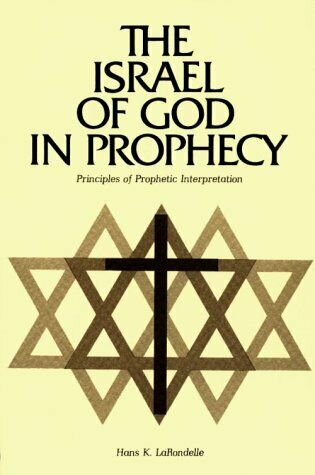
The Israel of God in Prophecy, by Hans K. LaRondelle is, in the broadest sense, a study of the principles of prophetic interpretation within the Bible. Within this broad scope, LaRondelle specifically focuses on the prophecies regarding Israel and seeks to prove that there is an organic unity between Old Testament Israel and the New Testament Church. To make his point, LaRondelle has chosen Dispensationalism1 (which argues for a strict separation between Israel and the Church) as his sparring partner. In the course of the book Dispensationalism is shown to be an inadequate view of Scripture that is both inconsistent and fails to interpret the Bible in light of Christ’s life, death, and resurrection.
LaRondelle’s principles of prophetic interpretation are grounded on the ideas that prophecy should be interpreted according to “those passages of Scripture which reveal the same terminology, imagery, or comparable redemptive events” and that “the New Testament is the authorized and authoritative interpreter of the Old Testament” (3). He seeks to make his arguments from the Bible and allow the Bible to speak for itself: a goal I believe he achieves just about flawlessly.
While LaRondelle is a Seventh Day Adventist and quotes from some SDA sources, it must be stressed that The Israel of God in Prophecy is in no way a defense of the Seventh Day Adventist church. LaRondelle presents biblical arguments for his position and against Dispensationalism.
Synopsis
Chapters 1-5
The book begins by establishing principles of interpreting prophecy and contrasting what LaRondelle suggests are biblical principles with the principles of Dispensationalism. LaRondelle first establishes the Christocentric focus of the Bible and argues that Christ is the key to both the Old and New Testaments. Next he discusses the main difference between his view and that of Dispensationalism, namely the question of what is the key to understanding the Old Testament. LaRondelle argues that the New Testament is the key to Old Testament prophecy, while Dispensationalism argues that Old Testament prophecy should be interpreted as literally as possible. Chapters 3-5 lays the groundwork for the book and analyzes the concepts of literal, allegorical, typological, and Christological interpretation of the Bible.
Chapters 6-9
After outlining in broad strokes both his and Dispensationalism’s principles of prophetic interpretation, LaRondelle next focuses on Israel. First he establishes that “Israel”, while it can refer to the nation of Israel, also has a theological significance in the Bible that refers not a nation, but to a dedicated people of God. In chapter 7 the question of whether or not the Church is referred to as “the Israel of God” is addressed, with LaRondelle showing that the affirmative is true. The next two chapters deal respectively with Paul’s use of the term “Israel” in Romans 9-11 and how the various Old Testament territorial promises ought to be interpreted.
Chapters 10-12
The last several chapters of the book focus on showing that the Dispensational interpretation of some key texts is wrong and providing an alternative, biblical interpretation. Special emphasis is placed on understanding the 70 weeks of Daniel 9 and whether or not the Bible supports the idea of a pre-tribulation rapture of the Church (LaRondelle argues that it does not).
Analysis
The Israel of God in Prophecy is a very needed antidote to the bad theology that has permeated much of Christianity in the US. Even though many aspects of Dispensationalism run counter to the Bible’s teachings, much of popular Evangelicalism and many seminaries hold to it with dogmatic conviction. It is very common for those raised in a Dispensational church to assume that the Bible teaches a pre-tribulation rapture of the Church followed by a restoration of the nation of Israel. The Scofield Reference Bible and books such as the Left Behind series help to reinforce this view.
LaRondelle does an excellent job of showing from the Bible that these Dispensational views are not taught in the Bible, but are rather forced upon the Bible due to preconceived ideas. But he does not simply deal with the bad fruit of Dispensationalism, rather LaRondelle goes to the root of the issue. He explains why the Dispensational principles of interpretation are inadequate and shows the reader a better, more biblical, way to interpret prophetic material in the Bible.
LaRondelle shows himself to be very familiar with the Dispensational view and quotes extensively from the Dispensational material available at the time of the book’s writing in 1983. He presents the view fairly but does not pull any punches when he points out its flaws and the negative theological implications of Dispensationalism.
Jesus is the Ultimate Interpreter of the Old Testament
The biggest strength of the book is LaRondelle’s commitment to Jesus as the key to understanding the Old Testament and the New Testament as the authoritative interpretation of the Old Testament. The principles he teaches in the book are principles derived from Jesus and the apostles’ handling of the Old Testament material. As he states, “God Himself is the interpreter of His Word” (17). According to LaRondelle the prophecies of the Old Testament cannot be isolated from the rest of Scripture. In fact, he says, isolating the Old from the New Testament “denies the theological unity of God’s Word” (13).
In the book’s concluding chapter he states the matter bluntly and asserts that “it is biblically unjustified to apply any old-covenant blessing unconditionally to the modern State of Israel in the Middle East, as if Christ had not yet appeared and the New Testament had not been written. No appeal to “natural” exegesis can be valid if it bypasses the cross of Christ” (209). This focus of Jesus being the ultimate key to the Old Testament is stressed throughout the book and is the point to which LaRondelle repeatedly returns to argue for his view and against Dispensationalism.
The 70 Weeks of Daniel 9
Much of the last two chapters is dedicated to the proper understanding of the 70 weeks of Daniel 9. Crucial to Dispensationalism is the belief that there is a separation between the 69th and 70th weeks, with the 70th week still awaiting fulfillment. LaRondelle does a masterful job of defeating the Dispensational view and showing from Scripture that the 70th week concluded shortly after Jesus’ resurrection and the result of that week was the destruction of Jerusalem. He points out that “the dispensational break in the unit of the seventy weeks destroys the very point in specifying seventy consecutive weeks” (173). Daniel 9, when understood correctly in the light of Scripture, is quite an amazing prophecy, as LaRondelle points out, but loses much of its force when it is misunderstood as it is by Dispensationalism.
The Israel of God and the Church
One of the main focuses of The Israel of God in Prophecy is showing that the Church and the Israel of God are one and the same. LaRondelle compellingly shows from Scripture, both Old and New Testaments, that there is only ever one people of God and today that people is found in the Church. He does point out that the common view of the Church replacing Israel is not quite accurate. Instead he points out that “the Church is the continuity of the Old Testament Israel of God; it has only replaced the Jewish nation” (210).
There is only one olive tree (Romans 11), one spiritual temple (Ephesians 2), one New Jerusalem (Revelation 21), one flock and one shepherd (John 10), and all who have put Christ on in baptism are part of that flock under the one Shepherd (210). As Paul tells us in Ephesians 4:4-6, “There is one body and one Spirit, just as you were called in one hope of your calling; one Lord, one faith, one baptism; one God and Father of all, who is above all, and through all, and in you all.” LaRondelle takes Dispensationalism to task and shows from Scripture that it is biblically unfounded to separate Israel and the Church.
Conclusion
The Israel of God in Prophecy is a great study of the principles of interpreting prophecy and, simultaneously, is a solid strike against Dispensationalism. It is well researched and documented and, at 210 pages, does not have unnecessary fluff; it is straightforward and to the point. The relatively short length also makes reading this book a very efficient use of study time. It is written in a very understandable way and should be accessible for the serious student who is familiar with the Bible and Dispensationalism.
LaRondelle has written a good introduction for the study of biblical prophecy and lays down Christ-centered principles that are faithful to the Scripture. For those who hold to Dispensationalism this would be a good place to start in order to consider well-articulated arguments against that view of the Bible. For those beginning a study of prophecy in the Bible, The Israel of God in Prophecy is a biblically faithful introduction and will help the student to avoid some common errors when interpreting prophecy. Overall this is an excellent book and can be read with benefit by any student or teacher of the Bible.
Further Reading
Notes
- According to gotquestions.org (which supports Dispensationalism), “Dispensationalism has two primary distinctives: 1) a consistently literal interpretation of Scripture, especially Bible prophecy, and 2) a view of the uniqueness of Israel as separate from the Church in God’s program.”
 Studies in the Bible