
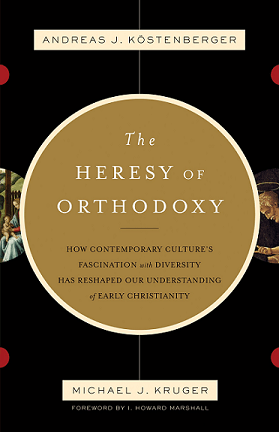
The Heresy of Orthodoxy: How Contemporary Culture’s Fascination with Diversity Has Reshaped Our Understanding of Early Christianity, by Andreas Kostenberger and Michael Kruger
Synopsis
In The Heresy of Orthodoxy Kostenberger and Kruger seek to show, as the subtitle of the book states, that “contemporary culture’s fascination with diversity has reshaped our understanding of early Christianity.” To assess this claim they use the Bauer thesis (what’s the Bauer thesis?) as a test case to show that, rather than truly weighing the evidence, much of current scholarship simply assumes that early Christianity contained many contradictory and competing opinions regarding core elements of the faith. The authors want to especially drive home the point that the Bauer thesis is held by many scholars, not because of the historical facts, but in spite of the historical facts that debunk this view. In their own words, “the debate is not about the details but about the larger paradigm – diversity” (18).
The Heresy of Orthodoxy is broken into three parts. Part 1 introduces the Bauer thesis and examines the extent of diversity found in the early church. Part 2 looks into the development of the New Testament canon. Finally, Part 3 covers the writing, collecting, and transmitting of the New Testament texts including a basic overview of textual variants.
Analysis
Both Kostenberger and Kruger have a very high view of the Bible and write this book to counter the “forces that seek to discredit the biblical message about Jesus, the Lord and Messiah and Son of God” (18). The general purpose of the book is to address the current obsession with diversity and how it affects our understanding of the history of Christianity, but the specific focus of the book is to show the flaws in the Bauer thesis and to present an alternative (i.e. traditional) understanding of Christian origins. The authors examine and dismantle the Bauer thesis point by point while simultaneously presenting a very strong defense of the traditional understanding of Christian origins. Particularly helpful was the analysis of the unity of Christianity over a wide geographic area at a very early date. The discussion of the legitimacy and development of the New Testament canon is also very good; however Kruger greatly expands this discussion in his subsequent books such as Canon Revisited and The Question of Canon.
This book covers a wide range of topics which makes The Heresy of Orthodoxy an excellent primer on the debate over early Christianity. This is a scholarly book with a lot of footnotes, but it is written so that most adults with an interest in the subject can understand the general idea, even if they don’t get all of the references to various historical figures.
Who Should Read It?
The Heresy of Orthodoxy is a must read, but only for specific groups. The reality is that most mature Christians sitting in the pew on Sunday morning will not take books such as The Da Vinci Code seriously nor do they care about the anti-Christian views of scholars such as Bart Ehrman. So who should read this book? Anyone who is interested in church history, those who have questions after encountering the anti-Christian view of early Christianity, or those who work with others who may have questions on the subject of early Christianity. If you’re preparing to go to university for majors such as Literature, History, or Religion, this book will help you to defend your faith from the attacks that will arise.
Verdict
The Heresy of Orthodoxy is a scholarly, but accessible defense of the traditional understanding of the origins of orthodoxy and heresy within Christianity. This is not the final book on the subject, but it does serve as an excellent primer to the debate over the nature of early Christianity. For Christians who are not particularly interested in historical debates or scholarly opinions, it’s sufficient to simply be aware of this book and to reference it as needed. However, if you or someone you know has questions after being introduced to an anti-Christian view of early Christianity, or if you would like to prepare yourself for when you do encounter that view, then The Heresy of Orthodoxy is a highly recommended read.
 Studies in the Bible