

Introduction
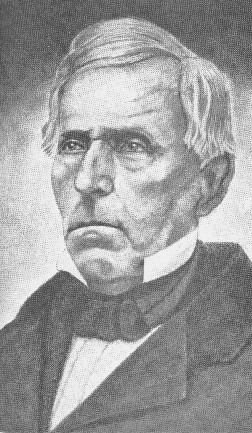
The Hazard of the Die: Tolbert Fanning and the Restoration Movement is a biography of Tolbert Fanning, one of the leading figures during the 19th century in what is called the Restoration Movement (the movement to return to the Bible, and the Bible alone, as our source of authority). Fanning was a farmer, teacher, college founder, preacher, journal editor, and entrepreneur. Fanning must have had a limitless supply of energy and resolve, and it seems somewhat fitting that it took a raging bull to bring him down. In The Hazard of the Die, Wilburn gives us a portrait of Fanning as an indefatigable idealist who not only knew what he hoped to accomplish, but took action to make it a reality.
Throughout the book, two aspects of Fanning’s life stood out prominently: his resolve to stand firmly on his biblical convictions and his passion for education.
Willing to Stand With the Bible
Several times in the book, Fanning’s resolve to stand with the Bible, even against severe backlash, was made evident. Perhaps the most striking instance of Fanning’s willingness to stand firm on his biblical convictions was his insistence on pacifism during the Civil War.
While Christians in both the North and South were calling for each other’s blood, Fanning insisted that Christians ought not get involved with politics or the wars of nations. Fanning was not alone in his calls for Christian unity and pacifism during the Civil War (for example, Benjamin Franklin was his pacifist counterpart in the North), he was certainly among a minority. He not only faced ridicule from his Christian brethren, but he also suffered great hardship when he refused to swear an oath of allegiance to the Northern occupying force in Nashville – he was willing to be an obedient citizen, but he was convinced that his oath of loyalty was to Jesus alone.
While the book does not go into detail of how Fanning came to his conclusions on the matter, for the interested reader On Civil Government, by David Lipscomb provides the biblical rational most likely used by Fanning. (David Lipscomb was a student of Fanning’s).
Teacher of Teachers
Among several educational enterprises (founding a girl’s school, editing several educational journals, an aborted attempt to found a world-class university), the establishment of Franklin College stands out as a remarkable success. Fanning was clearly passionate about education and wanted to increase the level of education among Christians, especially the youth. While Franklin College did not last into perpetuity, it served its purpose: it helped to produce a new generation of faithful Christians who themselves became teachers and preachers. Two notable alumni of Franklin College are David Lipscomb and T.B. Larimore, both of whom became highly effectual teachers, preachers, and school founders. Unlike some better known colleges, Franklin College did eventually cease as an institution. However, it is much better for an institution to serve its purpose and die an honorable death than to continue living, only to drift away from the faithfulness exhibited by its founder – an unfortunate trend of many institutions.
Christians Should Entrust Education Only to Christians
One interesting point made by Wilburn is Fanning’s change of opinion in regards to the Christian status of professors at colleges. When Franklin college was founded, Fanning hired some professors who were not Christians. However, by the end of his life, perhaps after witnessing the drift of other Christian colleges who employed non-Christian professors, Fanning was convinced that Christians should only entrust the education of their youth to trusted Christians. In today’s college climate, we would probably do well to heed the mature Fanning’s words.
Missing Some Detail, But Good Introduction
The book was an enjoyable read and I came away with a better understanding of Fanning’s life. I do wish that Wilburn would have gone into more detail as to why Fanning took a particular position and what his biblical arguments were. As it is, we are told that Fanning took certain positions, but why he took that position is not always made clear in the book. However, for what it is – an introductory biography – The Hazard of the Die does an excellent job of introducing the reader to an often unknown, but highly influential figure in the Restoration Movement.
Conclusion
James R. Wilburn did a great service to the church by providing an accessible biography of Tolbert Fanning. Many of Fanning’s attributes, not least his resolve and insistence on following the Bible, are worthy of emulation. As long as the reader has a general idea of the Restoration Movement then they will be able to read The Hazard of the Die with benefit. If the reader has no idea about the history of the Restoration Movement then they may be a little lost at times in the book, but would still be able to get much good from it.
Further Reading
Much historical information, including biographical sketches of Fanning, Lipscomb, and Larimore, can be found here: https://www.therestorationmovement.com/index.htm
 Studies in the Bible