

Introduction
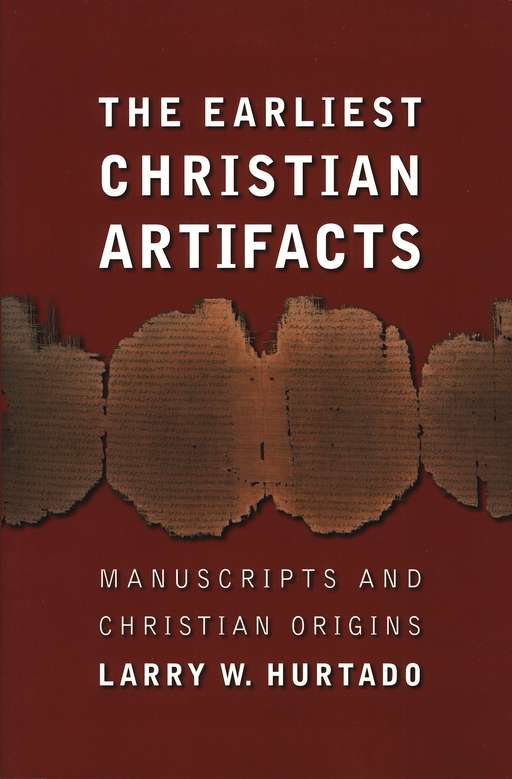
The Earliest Christian Artifacts, by Larry Hurtado, is a study of the physical features of early Christian manuscripts. Instead of describing and discussing the texts of the manuscripts, Hurtado is concerned in this book with the physical and scribal features of the manuscripts. In other words, Hurtado wants to discuss the manuscripts not simply as carriers of text, but as artifacts themselves. Hurtado’s conviction is that many features of early Christian manuscripts have important implications for the study of Christian history, yet they have often been neglected by scholars. The Earliest Christian Artifacts is intended to present data and ask questions in order to create scholarly dialogue.
Synopsis
The Earliest Christian Artifacts is divided into five sections: the texts, the early Christian preference of the codex, the nomina sacra, the staurogram, and other scribal features.
The Texts
The first section of the book is a brief overview of the early Christian texts available to us. The texts that Hurtado reviews in this section include not only New Testament writings, but also other Christian (or Christian-related) texts such as The Shepherd of Hermas, Against Heresies, The Gospel of Thomas, and others. Hurtado provides information such as the number of extant manuscripts and the type of manuscripts of each text (codex, roll, etc.). He then analyzes the data and discusses some implications of the data.
Early Christians and the Codex
In the second section of the book Hurtado focuses his attention on the strong preference of the codex among early Christians. The codex is the forerunner of the modern day book-form we are familiar with, but in the early centuries A.D. it was much less popular for writings when compared to the roll. What is remarkable is that Christians, beginning with the earliest extant manuscripts, had a strong preference for the codex instead of the roll. This is particularly true in regard to the New Testament writings. Hurtado gives an overview of the available data and discusses some possibilities as to why Christians preferred the codex over the much more widely used roll.
The Nomina Sacra and the Staurogram
The third and fourth sections of the book are overviews and discussions of the scribal features known as the nomina sacra (the sacred names) and the staurogram. The nomina sacra are abbreviations of names, particularly of the Greek words for Lord, God, Jesus, and Christ. The staurogram is a monogram of the letters tau and rho (physically similar to “T” and “P”) and is found within words related to “crucify”. Both the nomina sacra and the staurogram are found in the earliest extant manuscripts. Hurtado provides the data for these two scribal features and discusses what these unique abbreviations may suggest for the study of early Christianity.
Other Scribal Features
The book concludes by looking at some other miscellaneous physical features of early Christian documents. These features include the sizes of codices, the number of lines per page, number of letters per line, margin size, and reading aids (such as punctuation). Hurtado compares and contrasts these features to contemporary non-Christian writings and gives some possible interpretations of the data.
Analysis
Overall The Earliest Christian Artifacts was interesting and I learned a lot from it. The book’s topic is admittedly not the most exciting, but Hurtado writes well and presents the material in a way that keeps the discussion from dragging. There were some comments by Hurtado that I did not agree with (such as insinuating that 2 Timothy was not written by Paul), but I do appreciate that he writes about Christian origins from a generally conservative perspective. Also, in order to get the most out of this book the reader needs to have at least a very basic understanding of New Testament Greek and of the nomenclature for naming early Christian manuscripts. (New Testament Textual Criticism by David Black provides enough information on the latter subject).
The Interesting
There was a lot of new information that I received from this book and I’m glad that I’m now more familiar with early Christian documents. I knew that early Christians preferred the codex, but the data and charts showing the degree of that preference were enlightening. I was not familiar with the nomina sacra, staurogram, or the other physical features of early Christian writings and I found Hurtado’s presentation of the material easy to follow and interesting. What was especially interesting how the physical features of the many codices (lines per page, letter spacing, punctuation, etc.) appear to have been geared towards assisting public reading.
Anyone interested in early Christian writings, textual criticism, or Christian history would benefit from knowing about the information presented in The Earliest Christian Artifacts. Whether or not The Earliest Christian Artifacts is the best place to get that information will depend on the seriousness of the study.
The Not So Interesting
While the material presented was interesting, there were some points at which I felt like it was raw-data overload. However, this book is written to promote scholarly discussion, so a scholarly amount of data is probably necessary. Related to that, there are a lot of footnotes and Hurtado interacts with a lot of scholars which can get tiring at times (but again, this is intended to be a scholarly writing).
Conclusion
The Earliest Christian Artifacts presents some interesting features of early Christian manuscripts and rightfully looks at the manuscripts as artifacts worth studying. This book is directed more towards scholars than the average Christian in the pew and does require some prior knowledge in order to get the most out of it. The book is reasonably accessible to the non-scholar, but I think that it is too focused on scholarly discussion to be worth purchasing and reading for those not doing deliberate studies on the subject. However, for those studying early Christianity or textual criticism I would highly recommend this book; it is full of very useful data and insightful discussion of the data.
For those interested in the subject but not wanting to read The Earliest Christian Artifacts here are some links summarizing information on the nomina sacra and staurogram. Also, Hurtado passed away in 2019, but his blog is available here and contains free access to some of his articles.
 Studies in the Bible