

Introduction
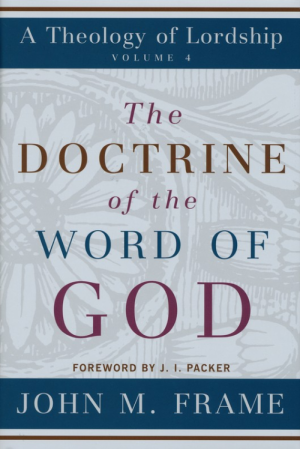
The Doctrine of the Word of God by John Frame is a systematic theology of God’s Word. This is the fourth and final addition to Frame’s Theology of Lordship series. Other books in this series include The Doctrine of the Christian Life, The Doctrine of God, and The Doctrine of the Knowledge of God. Each book in the series is standalone and it is not necessary to have read any of the other books in the series to make sense of The Doctrine of the Word of God.
While “the word of God” is often used to refer to written Scripture, Frame does not focus solely on written Scripture. The Doctrine of the Word of God is a systematic theology looking at God’s Word in every form: verbal, written, incarnate, etc. Frame discusses God’s Word from a theologically conservative perspective and asserts that God’s speech to man is real speech from one Person to another person (pg. 3). For Frame, and hopefully for us, God’s words in any form are completely trustworthy and the final authority on whatever subjects they address.
Synopsis
The Doctrine of the Word of God is divided into four sections followed by a series of appendices.
Part 1
The first two chapters of the book serve as an orientation and outline of how the topic at hand is going to be analyzed. Frame introduces the reader to his Personal-Word model of God’s Word which simply asserts that God’s words are real communications to us just as our words to one another are real communications. Frame also discusses God’s Lordship and the implications that Lordship has for the way we receive God’s words.
Part 2
In the second section of the book Frame reviews some of the history of opinion on God’s word. Along the way he provides helpful critiques to the many sub-biblical views of God’s word that have popped up over the centuries such as those held by Liberalism, Neo-Orthodoxy, and advocated of limited-inerrancy.
Part 3
The third section of the book looks at the nature of God’s word. Frame considers the nature of God’s word as God’s Controlling Power, Meaningful Authority, and Personal Presence.
Part 4
The fourth and largest section of the book describes the various media through which God’s words are received by mankind. Frame categorizes these media as events, words, and persons. Frame acknowledges that the three categories are not independent, nor are they perfectly distinct. Events communicate, but words are often needed to fully communicate the meaning of events. Persons, in their actions and words, can either present events, words, or both. Frame does especially focus in this part of the book on God’s Word as written Scripture. He considers topics such as Scripture’s ability to communicate God’s words without corruption, Scripture’s clarity and inerrancy, and Scripture “challenges”.
Appendices
The appendices are a collection of Frame’s writings throughout the decades which deal with God’s Word. Throughout the book Frame will point the reader to the appendices most relevant to the topic at hand. There are about three hundred pages worth of appendices which constitutes about half of the entire book.
Analysis
Overall I enjoyed reading The Doctrine of the Word of God. The book is too long to analyze in detail, so here we will note in broad principles the positives and negatives of the book.
Strengths of The Doctrine of the Word of God
The Bible Has the Final Word
The biggest strength of this book is that Frame makes a conscious effort “to be ruthlessly consistent with Scripture’s own view of itself” (7). For Frame the Bible has the final word, even in regard to itself. This is refreshing because scholarly books will often give too much credence to the “scholarly consensus”, even if that consensus is inconsistent with what the Bible claims. Frame does not fall into this trap. In fact, Frame (a scholar himself and respectful of scholarship) is surprisingly hard on the current state of Christian scholarship due to the trend of focusing on scholars’ opinions instead of the Bible’s teaching. He goes so far as to suggest that Christian higher education may need to separate itself from the current academic establishment in order to be more faithful stewards of God’s Word (pg. 278 note 6, also Appendix A).
Frame, while being of Reformed background, gives surprisingly little authority to creeds and confessions. This is not to say that he disagrees with them (in fact he spends some time interacting with the Westminster Confession), but he does repeatedly point out that creeds and confessions are always subservient to the Bible and should always be open to correction by the Bible. He respects creeds and confessions as teaching tools, but emphasizes that only the Bible can be absolutely binding on anyone. He argues for “Something Close to Biblicism” as the title of Appendix O says.
Sane Scholarship
Another strength is the book’s writing style. Frame writes with a relaxed and personal tone and does not get bogged down with abstract theorizing and speculation. As he puts it, “although we can learn from the history of doctrine and from contemporary theologians, the final answers to our questions must come from the Word of God itself. And I don’t think you need to look hard to find those answers. You don’t need to engage in abstruse, complicated exegesis. You need only to look at the obvious things and be guided by them” (7).
Some of the discussions touch on complex subjects and take some thinking, but Frame writes in such a way that a person with a basic understanding of the topics will be able to follow along just fine. Frame writes with the experience of a scholar, but writes primarily for the sake of the Church, not for the Academy.
Humble Confidence
The final strength we’ll consider is Frame’s humble confidence in the trustworthiness and authority of the Bible This simplicity and straightforward confidence in the Bible is refreshing and encouraging. Instead of trying to make the Bible say what we want it to say, Frame focuses on what the Bible in fact says. This especially comes into play when Frame addresses challenges to Scripture and when he critiques writers such as Peter Enns and others for their less than faithful view of Scripture. Frame is not afraid to say “I don’t know”, but he refuses to say that because he does not know, therefore the Bible is wrong. According to Frame, “no problem has such weight as to overturn the fundamental premise of Christian epistemology: that the Bible is God’s permanent personal word, given to us to be believed and obeyed” (184).
Weaknesses of The Doctrine of the Word of God
Calvinism
Frame does come from a Reformed background and his Calvinism does come through at times. When reading the book you’ll want to keep this fact in mind and be on the lookout for Calvinist views. However, I would still recommend this book to church leaders and those who are very familiar with what the Bible says. Every book has its good and bad, and this book has enough good to be worth sorting out the bad.
Tri-Perspectivalism
Frame and Poythress are advocates of what they term tri-perspectivalism. In very simple terms tri-perspectivalism is looking at the same thing from three different perspectives. While I don’t necessarily disagree with this or see tri-perspectivalism as a negative in and of itself, I simply think that the book gained nothing except distraction from the brief discussions of tri-perspectivalism. It would have been preferable to me had Frame simply used his tri-perspectivalism without pointing it out or explaining it. Having said that, this is a minor point and in no way makes me less likely to recommend the book.
Conclusion
Overall I thoroughly enjoyed reading The Doctrine of the Word of God and found it to be faith affirming, thought provoking, and informative. Frame’s confidence in the Bible, humble approach, and ability to distill complex subjects into straightforward discussion was refreshing and encouraging. Readers should be aware that Frame holds to Calvinism, but anyone who is familiar with what the Bible says will be able to reap the benefits of this book and ignore the bad. I would not recommend this book to a new Christian, but to anyone doing serious study on the doctrine of Scripture I would happily recommend The Doctrine of the Word of God as an excellent systematic study of God’s Word. (Here’s a link to buy the book on christianbook.com)
 Studies in the Bible