

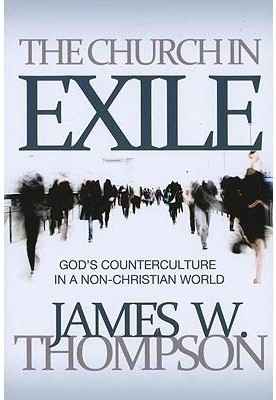
The Church in Exile: God’s Counterculture in a Non-Christian World, Revised Edition by James W. Thompson, Leafwood Publishers, Copyright 2010
The “alien” Christians who first read 1 Peter were not strangers in their own lands because of their skin colors or nationalities. Their obedience to the call of Christ had made them exiles. (13)
Overview
The Church in Exile: God’s Counterculture in a Non-Christian World by James W. Thompson is written for the church in the US as it finds itself within a culture whose morals are becoming increasingly antithetical to the morals of Christianity. In such a culture the church becomes a minority group that holds to teachings and beliefs that seem strange to the society around it. The Church in Exile addresses how the church ought to act in such a situation and what type of challenges the church will face as a minority group of spiritual and cultural exiles.
The book does acknowledge that the church is, at least in a spiritual sense, always exiles in this world, but the primary focus is on the cultural exile that the church in the US is beginning to experience. While taking an honest assessment of the challenges facing the church, Thompson never loses sight of the opportunities that arise with the challenges or of the hope that the Christian has in Jesus Christ.
Thompson uses the epistle of 1 Peter to draw comparisons between the cultural status and challenges of the church in the first century and those of the church in the twenty first century. As Thompson points out, “The epistle of 1 Peter offers an important resource because the recipients of this letter faced problems similar to our own, for they were aliens in their own land also” (34). The Church in Exile is not a verse-by-verse commentary, but each chapter of the book uses a section of 1 Peter as the starting point for its discussion. While 1 Peter is, surprisingly, not mentioned at all in the title of the book, The Church in Exile could be considered a devotional commentary on 1 Peter.
Writing Style
The Church in Exile is non-technical and, at 156 small pages (including 1-2 pages of discussion questions at the end of each chapter), a quick read. The book is written in a conversational manner and at the end of each chapter there are a set of discussion questions which could be useful when teaching 1 Peter in a Bible class. There are a few instances where Greek words are discussed, but all of the information needed to understand the point being made is provided. The book is written in such a way that any Christian would be able to benefit from reading it.
Verdict
The culture of the US appears to be moving away from Christian morals at an exponential rate which makes The Church in Exile even more relevant today than at its first publication. The Church in Exile would serve as an excellent devotional in conjunction with a more in depth study of 1 Peter, but it can also be read by itself to great benefit. As the church in the US faces cultural exile, parents and churches will especially need to prepare the youth to stand apart from and against society on many moral issues. The Church in Exile would be a useful resource to help prepare youth for the challenge of cultural exile and to teach them about the hope and strength we have in Jesus Christ.
 Studies in the Bible