
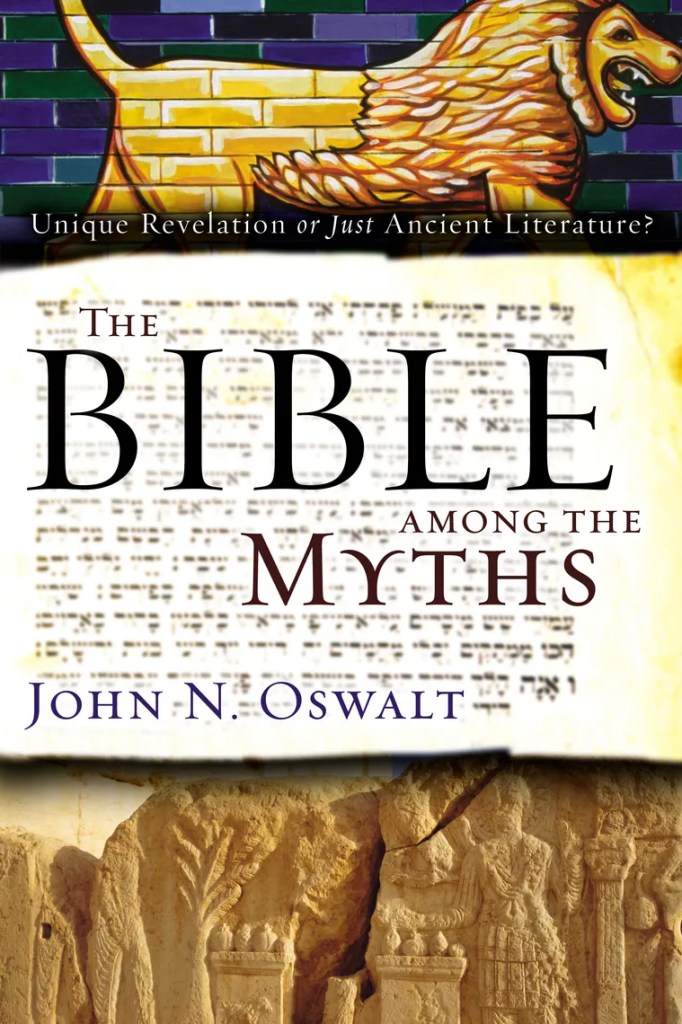
Current biblical scholarship tends to understand ancient Israel’s religion (i.e., Old Testament religion) as fundamentally the same as other religions in the Ancient Near East (ANE). “Not so fast,” says John N. Oswalt. In The Bible Among the Myths, Oswalt challenges the current tide of scholarship and argues that, despite superficial similarities, there are fundamental differences between the religion of ancient Israel and that of other ANE societies. The fundamental difference, according to Oswalt, is that of a worldview of transcendence (Israel) vs one of continuity (other religions). This fundamental worldview difference is what makes Israel’s religion unique, despite sharing in speech patterns and cultural references of its day. The book is divided into two parts, the first focusing on the Bible’s relation to myth and the second on the Bible’s relation to history.
The Bible and Myth
The first half of the book focuses on the question: what is myth and can the Bible properly be referred to as such. Oswalt is careful to define myth and points out that many current definitions of myth appear to be deliberately constructed in order to break down the division between the Bible and ANE literature (31). Oswalt’s conclusion is that, “whatever the Bible is, it is not myth” (47).
Continuity vs Transcendence
The reason that the Bible is not myth goes back to the fundamental difference between Israel’s religion and that of other ANE societies: the difference between continuity and transcendence. The religions of other ANE societies – in fact, practically all religions other than Judaism, Christianity, and Islam (44) – have an underlying worldview of continuity. Put simply, continuity is oneness: “all things that exist are physically and spiritually part of one another” (49). Israel, on the contrary, has a worldview of transcendence: the Creator God is separate from creation, and yet interacts with His creation while remaining distinct from it. It is the difference in foundation that makes Israel’s religion different from other ANE religions.
The Bible and History
The second half of the book focuses on the Bible’s relation to history. Oswalt first defines history and then considers 1) is the Bible historical and 2) does it matter. Oswalt concludes that, based on the Bible’s worldview of transcendence, history is not only possible, but necessary. In his words, “The Bible refuses to allow us to create a split between fact and meaning. In fact, the entire Bible is historical in that in its entirety it is an interpretation of the historical experience of Israel culminating in the life, death, and resurrection of Christ” (153). Oswalt defends this assertion against two 20th century arguments against it: Bultmannian-Existentialism and Process Thought.
Why is Israel Different?
If Israel is so unique in its underlying worldview, where does this difference come from? Oswalt briefly outlines and critiques four suggestions that reject the Bible’s own explanation, those of 1) John Van Seters, 2) Frank Cross, 3) William Dever, and 4) Mark Smith. Oswalt concludes that each of these alternatives fails to persuade and that the simplest, most satisfactory conclusion is to accept the Bible’s own explanation: the transcendent God actually intervened in history and completely changed Israel’s religious path (184).
Assessment
The Bible Among the Myths is a refreshing counter-argument to the common idea that the Old Testament is fundamentally the same as other ANE religious texts. Oswalt provides a compelling argument that there is a fundamental difference between the two based on a difference in worldview: continuity vs transcendence. He also does a good job highlighting how a worldview of transcendence relates to history and how the Bible cannot be separated from actual, historical events.
The book is accessible for those interested in the subject, but a basic grasp of the issues addressed would be helpful. Oswalt is only able to present the tip of an iceberg of scholarship, but he does an excellent job focusing in on the foundational issues. He is not able to answer every question or provide extensive comparison of texts, but he does a good job equipping the reader with an understanding of the underlying, fundamental issues to prepare them for further reading on the subject.
 Studies in the Bible