

Introduction
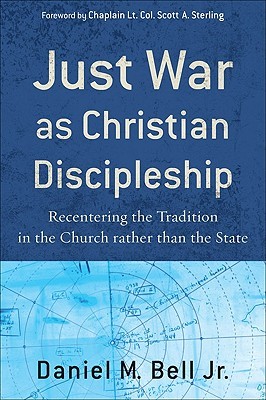
Just War as Christian Discipleship: Recentering the Tradition in the Church rather than the State is a presentation of the Just War Theory from a Christian perspective. The focus of the book is to compare and contrast Just War from a Christian perspective with Just War from a secular perspective.
Bell does an excellent job of comparing these two different views of Just War and presents a detailed view of what Just War would look like from a Christian perspective. What Bell does not do is provide a Biblical defense of Just War, nor does he go into much detail about the in-house debate among Christians about whether or not Christians should go to war at all. This was surprising, and a bit of a letdown, but when the book is judged for what it is, and not for what it isn’t, what we are left with is an excellent introduction to the Just War theory from a Christian perspective. Whether or not you agree with all of Bell’s assertions, this book is worth reading for those interested in Just War Theory.
Synopsis
Bell opens the book by explaining the origins of Just War Theory and how it was appropriated and modified by Christians. Bell does acknowledge that Just War (or Christian participation in war at all for that matter) was not immediately accepted by Christianity, but that it slowly took root and became firmly established after Constantine. The contributions of Augustine, Aquinas, Vitoria, and Grotius are especially focused on during the historical survey. After laying the historical groundwork of Just War Theory within Christianity, Bell then surveys how Just War is currently viewed by secular governments and the historical forces that have shaped that secular understanding.
After surveying both Just War as Christian discipleship (abbreviated Just War (CD)) and Just War from a secular perspective (what Bell calls Just War as Public Policy Checklist, or Just War (PPC)), the two perspectives are compared. The remainder of the book is spent comparing and contrasting Just War (CD) and Just War (PPC) in the categories of Legitimate Authority, Just Cause, Right Intent, Last Resort and Reasonable Chance of Success, and Discrimination and Proportionality. Bell then concludes the book with a summary and a focus on the radical nature of Just War (CD) as opposed to Just War (PPC).
Analysis
Lack of Biblical Argument
Just War as Christian Discipleship was both disappointing and interesting at the same time. I went into the book expecting it to be a Biblical defense of Just War, but that is not what this book is about. In fact I was quite disappointed at the overall lack of reference to the Bible when presenting Just War as Christian discipleship. Not that Bell never references the Bible; I just assumed it would be a primary reference source throughout the book and it was not. Augustine, Vitoria, and Grotius were the primary Christian sources throughout the book and their views are more or less assumed to be correct and are never defended on Biblical grounds.
The fact that Just War was not defended from the Bible was more striking when we consider that Just War as a tradition has its roots in ancient Greece and Rome, not in the Bible. It’s okay to use traditions from outside of the Bible, but when we are going to give a tradition authority it is appropriate to present a Biblical defense of why that tradition should be given authority in a Christian’s life.
Significant Undefended Assumption
The underlying assumption of the book, that Christians can and should fight in just wars, was never defended on Biblical grounds. I understand a book has to have a limited scope, but this was very disappointing since Bell acknowledges the general anti-war posture of many early Christians before he simply agrees uncritically with Augustine that “times change” (pg. 28). I think it is clear that this is generally not a safe way to interpret the Bible and when an understanding of the Bible is radically changed over time we need to slow down and know the details of the argument that led to the change in understanding.
Despite the Flaws, Still An Interesting Discussion
The above disappointments aside, I did find the book interesting. I was not familiar with Just War as a specific theory and found the discussion very enlightening. The historical surveys of both Christian and secular views of Just War were well presented and provided a solid foundation for analysis in the second half of the book. I also liked how Bell focused on reconciling with enemies, especially after a war, and that he was aware that the model of Just War as Christian discipleship is a radical reinterpreting of how war should be conducted. As Bell says, “Just War (CD) is an act of faith in God” (pg. 241).
While I did not necessarily agree with his all of his views, I did very much appreciate that Bell understands that for a Christian it is not enough to participate in war because it is a lesser evil. If a Christian is to participate in war it must be because war is objectively the right thing to do. Fighting in a war must be the correct Christian response, not just a lesser evil done trying to stop a greater evil. However, I would have liked him to give a Biblical defense of why going to war is at times the right thing for Christians to do.
Theoretically Good, Practically Not Possible
As Bell compared and contrasted the Christian and secular views of Just War I found his depiction of how a Christian should go about behaving before, during, and after war insightful and theoretically accurate. If I were to say that Christians should fight in wars then I would have to agree with Bell and say “this is how we should go about war”. However, I deliberately used the words “theoretically accurate” because I think that Bell’s presentation of Just War as Christian discipleship is exactly that: theoretical. Repeatedly throughout the book I found myself thinking, “That’s good and all, but secular governments don’t work like that and the Church doesn’t have a military”. Soldiers do not pick and choose their battles, nor can they reject orders without severe consequences.
So, in an ironic twist, I think that Bell, by showing that there is such a vast difference between the Christian and secular vision of war, shows that, despite whatever theoretical appeals to Just War a Christian can make, it is probably not actually possible to follow through with the idea in real life.
Conclusion
If you are interested in how the Just War Theory and Christian tradition intersect then Just War as Christian Discipleship is a good introduction despite its flaws. I would have liked to have read more of a Biblical defense of Christians going to war in general and of Just War in particular. In this book Bell focuses on comparing and contrasting the Christian and secular views of Just War. This comparison is done well and Bell provides lots of food for thought, even though he does not provide a lot of Scripture to back up his analysis.
Assuming that Christian’s can indeed fight in wars, I think Bell has presented a very good description of what that fighting should look like. However, despite Bell’s able defense of Just War as Christian discipleship, I came away from the book convinced that Bell’s concept of Christian Just War may be good in theory, but it is not possible in the real world. If you are convinced that Christians should not fight in wars or if you’re looking for a Biblical defense of why Christians can fight in wars then Just War as Christian Discipleship is probably not the best resource. If you are convinced that Christian’s can fight in wars or if you are interested in Just War as a theory, then I would recommend Just War as Christian Discipleship as a good introduction to and analysis of Just War.
Here is a link to the book on Amazon
 Studies in the Bible