

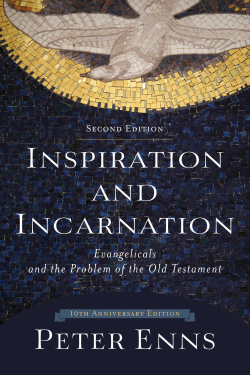
Instead of Inspiration and Incarnation read:
- Christ and the Bible, by John Wenham (a full review can be found here)
- Handbook on the New Testament Use of the Old Testament, by G.K. Beale
- [The Bible Among the Myths, by John Oswalt]
Critiques of Inspiration and Incarnation:
- Paul Helm’s critique here
- John Frame’s critique here or on pg 499-516 in The Doctrine of the Word of God
- [The Erosion of Inerrancy, by G.K. Beale]
[Brackets indicate that I have not had the chance to read the book in full, but from what I know of it I believe it will be helpful]
Review
The stated goal of Inspiration and Incarnation is to create dialogue among evangelicals regarding biblical inerrancy, especially as it relates to the Old Testament. In this regard it did succeed – the book was popular enough to receive a tenth anniversary second edition and is often required reading in seminaries (both for positive and negative interaction). Unfortunately, the unstated goal of the book appears to be a deconstruction of biblical inerrancy and authority. Enns wrote Inspiration and Incarnation while still claiming to hold to (some view) of biblical inerrancy. However, throughout the book one is left with a gut-feeling that there is something Enns is really trying to say that he won’t explicitly state. That gut-feeling is proved true by Enns’ subsequent writings in which we see exactly what kind of tree the seed of Inspiration and Incarnation grows into: a complete rejection of biblical inerrancy and an embracing of postmodernism.
Enn’s Concerns
Inspiration and Incarnation addresses three broad topics which Enns believes to be problems for those holding to a traditional view of inerrancy: Ancient Near Eastern (ANE) texts that have elements similar to the OT, diversity within the OT, and the NT’s use of the OT. Enns offers an “incarnational model” to handle these perceived problems which tries to draw an analogy between Jesus’ incarnation (human and divine) and the nature of Scripture. While this incarnational model sounds good at first (after all, the Bible is both human and divine) it doesn’t make much sense when Enns treats the Bible as a completely human book. For example, he suggests that the OT is just another example of an ANE text (including mythological accounts) and that the OT contradicts itself.
What’s Wrong With The Book
Detailed critiques by others have been listed at the beginning of this article, so here we will simply list in broad terms a few problems with the book. One of the biggest problems is that Enns gives final authority, not to the Bible, but to the “scholarly consensus” of science, archaeology, and anthropology. For Enns the Bible must give way to the available data (or rather to the majority interpretation of that data) and cannot simply stand on its own “thus says the Lord”. Also, while Enns repeatedly emphasizes his “incarnational model” he never fully fleshes out what that means in real-life terms for our understanding of the Bible, nor does he follow his model to its logical conclusion of a rejection of the Bible’s inerrancy and authority. Other problems include treating non-issues as if they were major issues and making no distinction between diversity and contradiction. Overall there is a lot of deconstruction and very little construction in Inspiration and Incarnation.
Conclusion
Short and sweet: I highly recommend not reading Inspiration and Incarnation. If you must read it be sure to read the critiques mentioned at the beginning of this article as well.
 Studies in the Bible