

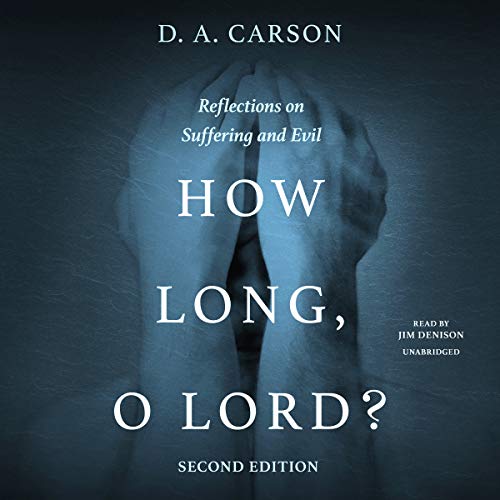
Verdict: 5/5, A beneficial reflection on suffering from a thoroughly Christian perspective. Highly recommended for thoughtful Christians and church leaders.
Introduction
“How Long, O Lord” by D.A. Carson is a reflection on suffering and evil written by a Christian, for Christians. Carson states from the outset that he’s not trying to build an apologetic to convert Atheists, but is instead seeking to get Christians to think about suffering from a biblical perspective. As he observes, one of the reasons that Christians are often so disoriented by suffering is because they have failed to think carefully and thoroughly on the subject before the shock of suffering affects them. Or even worse, many Christians have thought about suffering, but only through the lens of the “health and wealth gospel”. It is Carson’s conviction that thinking deeply on the subject beforehand can provide a biblical framework through which Christians can process suffering and evil when it occurs. Carson has done an excellent job in guiding the reader into the deep waters of thinking through suffering and evil in light of God’s revelation in scripture.
Heavy, Scriptural, and Pastoral
No punches are pulled as Carson considers suffering and evil. The reader is not allowed to think of muted, ambiguous concepts. Instead, the reader is forced to consider real, serious suffering and evil by the use of specific, real-life examples. Poverty, war, disease, the suffering of Job, and more are discussed in detail. The appendix to the book considers AIDS as a very specific example of suffering and provides a thorough consideration of that disease in light of the book’s discussion.
Carson also does an admirable job of holding tightly to God’s revelation in scripture. God is sovereign over creation, even over evil, and yet mankind is responsible for its actions. God is pure, holy, just, loving, merciful, and he displays these attributes most notably in the crucifixion of his Son. Carson pulls all of these concepts and more together while also leaving room for mystery that is simply beyond man’s ability to comprehend this side of heaven.
While the book is certainly philosophical and thought provoking, it is also highly pastoral. Carson speaks as one who suffers, to those who suffer. When sin is pointed to as one reason for suffering, we are reminded that we are all sinners in need of grace. Carson reminds us that when we suffer we can look to our God who is himself personally acquainted with suffering. Grief is never trivialized or belittled, but acknowledged as something even the strongest Christian will experience. Above all, Carson seeks to provide a framework through which Christians can process suffering and evil without falling into the all too common trap of doubting God’s goodness or presence when confronted with their reality.
On Free Will
The one part of the book that some Christians may not agree with is Carson’s representation of the nature of free will. Carson even acknowledges that not all Christians agree (he names William Lane Craig as one who disagrees with him). As long as you agree that God is sovereign over all things, man is responsible for his actions, and God cannot be charged with sin, then whether or not you agree with Carson’s exact representation of free will won’t change the benefit of the book.
Conclusion
Overall, this was a thoroughly beneficial (though not necessarily “enjoyable”) read and I would recommend it to any thoughtful Christian. Carson does at times have to dip into some deeper philosophical concepts, but the book as a whole is written at an accessible level. Carson even states up front that some chapters can be skipped if the reader does not want to wade through the more cerebral portions of the discussion. As Carson points out, this book is best read before experiencing suffering, but it would be helpful for anyone at any point in life. I know that I have benefited from reading this book and it has certainly helped me to think more deeply and biblically on the nature of suffering of evil.
For those who like audiobooks, I listened to the audiobook on Audible which has an excellent voice performance.
Book Outline:
Part 1: Thinking about Suffering and Evil
1. First Steps
2. False Steps
Part 2: Parts of the Puzzle
3. The Price of Sin
4. Social Evils, Poverty, War, Natural Disasters
5. The Suffering People of God
6. Curses and Holy Wars – and Hell
7. Illness, Death, Bereavement
8. From the Vantage of the End
9. Job
10. The Suffering God
Part 3: Glimpses of the Whole Puzzle
11. The Mystery of Providence
12. The Comfort of Providence
13. Some Pastoral Reflections
 Studies in the Bible