

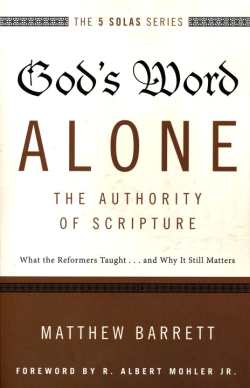
God’s Word Alone: The Authority of Scripture, by Matthew Barrett, part of the 5 Solas series edited by Matthew Barrett, Zondervan, 2016
Introduction
God’s Word Alone, by Matthew Barrett is part of the 5 Solas series that was written in light of the 500th anniversary of the Protestant Reformation. Each book in the series is meant to cover one of the “solas” of the Reformation: sola scriptura (scripture alone), sola gratia (grace alone), sola fide (faith alone), solus christus (Christ alone), soli deo gloria (to God alone be glory). This book is intended to cover the concept of “sola scriptura”: scripture alone. While “scripture alone” usually connotes the sufficiency of scripture, God’s Word Alone broadens the scope of discussion by addressing not only scripture’s sufficiency, but its authority (of which sufficiency is a subcategory).
Synopsis
The book is divided into three parts: a historical survey (Reformation to the present) of the authority of scripture, a biblical theology of scripture, and finally a systematic overview of the authority of scripture.
Part I: Historical Survey
The historical survey is divided into three sections: the sixteenth century, the Enlightenment to the early 1900’s, and the present. The sixteenth century focuses on the views of the magisterial reformers, the radical reformers, and the Roman Catholics. In the second section Barrett gives the broad contours of how the autonomous reason of the Enlightenment bled into theological Liberalism which was then countered by Christians such as J. Gresham Machen. Finally, the discussion of the state of scripture’s authority in the present-day focuses on the influence of Karl Barth, evangelicalism, and postmodernism.
Part II: Biblical Theology
The biblical theology looks at God’s revelation in general, God’s covenant words, and the assured truth of God’s words. This section is particularly concerned with the Bible’s own view of itself. It presents examples of God speaking and of how people reacted to that speech as well as the various covenants that God makes throughout the Bible. This section also shows how Jesus and the apostles viewed the authority of the Bible.
Part III: Systematic Overview
The systematic overview in the third section discusses scripture’s inspiration, inerrancy, clarity, and sufficiency. A chapter is devoted to each of these four attributes and Barrett defends each of the attributes against old and new objections. In these chapters Barrett builds a biblical defense of these attributes and gives special attention to pointing out the problems with the views held by limited inerrantists and Roman Catholics.
Analysis
When I opened this book I was surprised to see how broad the scope of the book was and how little space was dedicated to the specific point of the sufficiency of scripture. Barrett explains the reason behind this by pointing out that sola scriptura is not just about sufficiency, but also relates to all aspects of the authority of scripture (pg. 333). While I understand his point, I was slightly disappointed that more space was not spent on the topic of scripture’s sufficiency. The discussion on scripture’s sufficiency was not bad (in fact it was quite good); I just wanted to go a bit more in depth.
I’ll also note here that while I enjoyed reading the book I strongly disagree with Barrett’s Calvinism that shines through periodically. I also lean more towards what Barrett describes as nuda scriptura (a.k.a. Biblicism; basically not giving any true authority to tradition). Even with these disagreements, I appreciate that Barrett takes a strong stance in defense of the authority of the Bible.
Part I: Historical Survey
The historical survey was very interesting and helped to develop the background for the present-day debates about scripture’s authority. While all three sections of the survey were interesting, my comments here relate to the first section: the sixteenth century.
For the author, the magisterial reformers (Luther, Calvin, Zwingli, etc.) are the good guys in the story. From that perspective, the radical reformers (Anabaptists, Spiritualists, Rationalists, etc.) are bad guys and the author depicts them as such. While I agree that the Spiritualists and Rationalists were not faithful to the Bible’s teaching, there are groups within the Anabaptists that I would consider to be pretty good.
History is rarely clean-cut. For all of the good that Luther, Calvin, and Zwingli certainly contributed, they also had major flaws. On many points they did not reach true biblical understanding and those mistakes live on today. It was interesting to me that while the author was presenting Menno Simons (founder of the Mennonites, considered a radical reformer) as one of the bad guys, I found myself agreeing with Menno against Luther. Despite my differences with the author, as a whole the historical survey was an enjoyable and informative read.
Part II: Biblical Theology
The biblical theology was also interesting and would be especially helpful for those not very familiar with their Bibles. However, if you’re not very familiar with your Bible, definitely don’t read this book, go read your Bible! The focus on the biblical theology section is that God speaks words as a covenant, and what God says is sure to come to pass. Barrett also looks at how Jesus and the apostles viewed scripture, but if you’re interested in that subject then I would recommend reading Christ and the Bible. This was a good read, but if you are familiar with how the Bible treats God’s words then this section will probably just be a good review of the material.
Part III: Systematic Overview
The systematic overview of the doctrine of scripture was good, but the first three sections (inspiration, inerrancy, and clarity) seemed to be more of a condensing and restating of other books I’ve read. If you’ve read Christ and the Bible, Fundamentalism and the Word of God, and A Clear and Present Word there’s not going to be any new information in these sections. If you have not read those three books and have no interest in doing so, then God’s Word Alone could serve as a Reader’s Digest. However, if you are really interested in the topics addressed in this section, then I would strongly recommend reading the aforementioned three books instead of God’s Word Alone.
The section on sufficiency was good and I enjoyed reading it. As I mentioned above, I lean more towards nuda scriptura, so I think that Barrett has a slightly too high view of tradition. However, as one who sees great benefit in knowing and learning from history and tradition, I am sympathetic with Barrett’s attempt to balance the benefit of tradition with the authority and sufficiency of scripture.
Conclusion
All in all, God’s Word Alone, despite its flaws, is a decent book. It is a surprisingly easy read considering how many footnotes it has, and it is at times insightful. If you are looking for an in depth discussion of the authority of scripture, then I would recommend passing on this book, but the book could be useful as a primer. Having said that, the author is very Calvinistic and has a higher view of tradition than I’m comfortable with, both of which temper my excitement for it.
If you are fine weeding out the Calvinism, then God’s Word Alone is a decent introduction to the doctrine of scripture. If you can only choose one book to read about the authority of the Bible, then I would recommend Christ and the Bible or Fundamentalism and the Word of God over this book. If you are wanting a full blown study of the doctrine of scripture I would recommend John Frame’s The Doctrine of the Word of God which, even in spite of its Calvinism, is very much worth reading for the serious student.
 Studies in the Bible