

Introduction
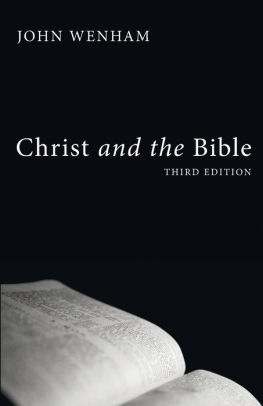
Christ and the Bible, by John Wenham, is a call for Christians to hold fast to the Bible as inerrant. The inerrancy of the Bible has come under fire from skeptics, but just as damaging, if not more so, has been the attack on inerrancy from within Christianity itself. It is an unfortunate fact that there are many who claim to be Christians who either outright deny inerrancy or seek to redefine what it means for the Bible to be inerrant (which amounts to a de facto denial of inerrancy). Wenham is not writing to convince the skeptic of the inerrancy of the Bible, rather he is writing to those who profess to be Christians. The crux of Wenham’s argument is that if one is to be consistent in calling Jesus “Lord” he must submit to Jesus’ view that “what Scripture says, God says” (195).
The first five chapters of the book focus on what Jesus and the apostles said and implied about the Scriptures. The last two chapters address the question of Canon (how do we know we have the right books) and the reliability of the text of the Bible.
Why Christians Should Hold To Inerrancy
Old Testament
Wenham’s argument for the inerrancy of the Old Testament is very straightforward: Jesus held the Old Testament to be inerrant; therefore to truly follow Jesus as our Lord requires us to hold to the inerrancy of the Old Testament. Wenham builds this argument by providing explicit quotes from Jesus regarding the nature of Scripture and by looking at how Jesus quotes from and makes use of the Old Testament. It’s also shown that all of the New Testament, not just the Gospels, assumes the inerrancy of the Old Testament.
New Testament
If the reader is convinced by Wenham’s argument for the inerrancy of the Old Testament, then the New Testament shouldn’t be a problem; normally it’s the Old Testament that Christians have a problem accepting as inerrant. Beginning with verses such as John 14:26 and 16:13 Wenham builds a strong case for the inerrancy of the New Testament based on how Jesus viewed his apostles, how the apostles viewed themselves, and the role of the Holy Spirit.
A Strength of Wenham’s Method
One of the biggest strengths of Wenham’s methodology is that it goes beyond the never ending questions from critical scholars. Wenham does answer several questions raised against inerrancy, but his methodology in large part circumvents the Bible critics. If the Gospel accounts are substantially true, and if a person claims that Jesus is their Lord, then they are constrained to hold the Bible as inerrant. The Christian can research and address questions from Bible critics if they so choose, but Wenham shows that the Christian can be confident in the inerrancy of the Bible without being overly concerned with the objections raised by Bible critics.
The Biblical Canon and the Reliability of the Biblical Text
In the last two chapters of the book Wenham addresses two questions that have implications for inerrancy: “how do we know we have the correct books?” and “how do we know we have the correct words in those books?”. After all, what good is inerrant Scripture if we don’t even have the Scripture? The very nature of these questions makes the discussion more complex and subjective than that found in the first five chapters of the book, but Wenham serves as a good guide through the labyrinth of Canon and textual debates.
The biggest challenge of these types of questions is that they cannot be answered with a simple book, chapter, and verse; we are asking questions not only of the Bible, but about the Bible. Despite this inherent difficulty Wenham writes in a way that is easy to follow and he continues to present a strong defense in favor of the inerrancy of the Bible. While I’m not sure that I agree with every statement in Wenham’s discussion on Canon, I did agree with the vast majority of it and found all of it very informative and thought provoking.
Conclusion
Christ and the Bible is a highly recommended read, especially for those struggling with the question of the trustworthiness of the Old Testament. The first five chapters of the book can be easily read and understood by any Christian to great benefit. The last two chapters will likely introduce many readers to names and concepts they have not heard before and will require a little more effort to read through; however, Wenham provides a safe introduction to these concepts and constantly shows why we should trust the Bible.
There is a great need today for Christians to reaffirm their faith in the inerrancy of the Bible. Christ and the Bible is an excellent resource to help Christians see that if they are truly to be followers of Christ then they must also follow Christ in understanding the Bible as the inerrant word of God.
Here’s the link to the book on Amazon
 Studies in the Bible