

Introduction
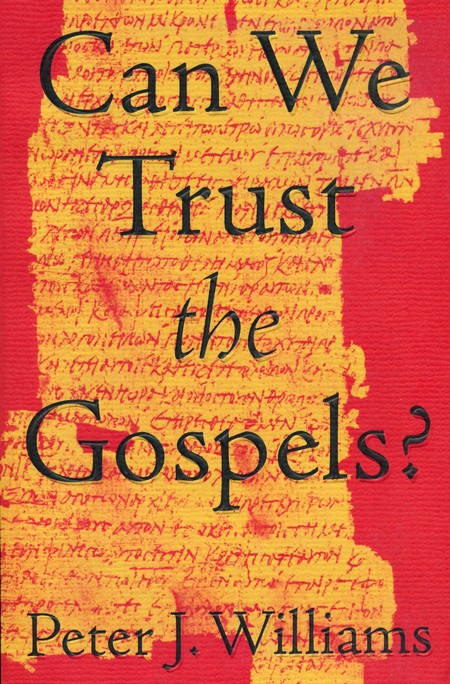
Can We Trust the Gospels?, by Peter J. Williams, is a succinct defense of the trustworthiness of the four Gospels. While the target audience is “those who are thinking about the subject for the first time” (13), the book introduces arguments for the reliability of the Gospels that would also be beneficial for those who have thought about the subject for a long time. The book is a relatively quick read, but there is an abundance of information packed into it.
Williams begins with a brief look at what ancient non-Christians had to say about Christianity followed by a general introduction to the four Gospels. The heart of the book is chapters 3-7 in which the author presents a plethora of arguments in favor of the reliability of the Gospels. The final chapter of the book, Who Would Make All This Up?, seeks to drive home the point that “Accepting the Gospels’ own presentation of Jesus actually provides the best single explanation for a whole range of phenomena in the Gospels that would otherwise require complicated explanations” (137).
The Good
Can We Trust the Gospels? is an excellent introduction to many of the arguments in favor of the reliability of the Gospels. While the entire book was good, chapters 3, 4, 6, and 8 were particularly powerful.
Chapter 3
Chapter 3, Did the Gospel Authors Know Their Stuff?, is the longest chapter in the book and takes a look at the details found in the Gospels. Williams argues that if it can be shown that the authors of the Gospels are accurate and trustworthy in the small details regarding “the time and places they wrote about” then we can at least eliminate “the objection that they were too distant from the events to be trusted” (51). Williams proves his point by showing the accuracy of the Gospels in details such as geography, names, finances, and local customs. While the level of detail found in the Gospels is impressive by itself, Williams emphasizes the importance of these details by comparing what is found in the Gospels with the details, or lack thereof, in later writings such as the “Gospels” of Thomas and Judas.
Chapter 4
In chapter 4, Undesigned Coincidences, Williams shows that there are details found in some Gospels that either fill in missing details in other Gospels or fit perfectly with the details in other Gospels. The details in these cases are so small or seemingly inconsequential that it is very unlikely that the authors deliberately added them in order to appear authentic. The argument was very interesting and I look forward to reading more on the subject in Lydia McGrew’s book Hidden in Plain View: Undesigned Coincidences in the Gospels and Acts which Williams references as a source for his discussion (87).
Chapter 6
Chapter 6, Has the Text Changed?, makes the point that we have enough confidence in the accuracy of our current Bible text to force the burden of proof onto the skeptic. As the associate editor of The Greek New Testament, Produced at Tyndale House, Cambridge (117), Williams is particularly knowledgeable on the Greek texts of the Bible and uses his expertise to present a strong argument against the idea that the text of the Bible is too corrupted to be trusted.
Chapter 8
Chapter 8, Who Would Make All This Up?, is the conclusion of the book. A few more arguments are presented and then all of the arguments in the book are brought together to form a formidable, cumulative argument. While any one of the arguments in isolation could be explained away, when all of the arguments are brought together the skeptic must provide increasingly complex solutions that in any other circumstance would be considered fantastical and absurd. As Williams observes, “A far easier position is to make a single supposition, that all of history hangs on Jesus. It is a single and simple supposition, but I am not claiming that it is a small one” (140).
The Not So Good
While the book is excellent overall, there is one misstep that stuck out. On pages 44-47 Williams, without naming it, makes reference to the Synoptic Problem (i.e. do the Gospels have any literary dependence with one another and if so what is the nature of that dependence). The Synoptic Problem is hotly debated, very complex, and has many well-educated people on every side of the argument. A topic as complex and divisive as the Synoptic Problem should probably be avoided in an apologetic text targeting “those who are thinking about the subject for the first time”. Beyond that, it’s impossible to provide an adequate or balanced discussion on the issue in only three short pages. Most of pages 44-47 could be removed without detriment to Williams’ argument.
Having said that, the book is still a great defense for the reliability of the Gospels. Although the book would be improved with the absence of much of pages 44-47, I would still feel comfortable giving the book to an older teen or adult who is struggling with the question of the reliability of the Gospels.
Conclusion
Can We Trust the Gospels? succeeds in building its case for the trustworthiness of the Gospels. The book is a quick, interesting read and would be beneficial for those interested in apologetics and for those asking the question, “How do I know that the Gospels are reliable?”. Will it turn a hardcore skeptic into a believer? Probably not. But for the person who is truly struggling with the question of whether or not the Gospels are reliable sources this is an accessible book that could help push them from questioning to trusting. If you are at all interested in apologetics or the Gospels, Can We Trust the Gospels? is worth taking the time to read and will help to strengthen your confidence in the trustworthiness of the Gospels. (Here is a link to the book’s Amazon page)
 Studies in the Bible