

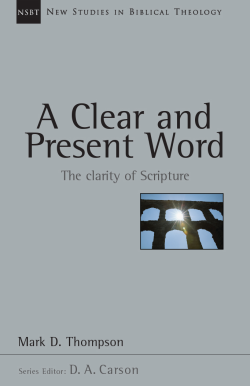
A Clear and Present Word: The Clarity of Scripture, Mark D. Thompson, part of the series New Studies in Biblical Theology edited by D.A. Carson, InterVarsity Press, 2006
Introduction
The clarity of Scripture is a foundational belief of Christians. After all, if the Bible is not clear then how can a Christian know that he has understood correctly? Likewise, if there is no such thing as objective truth in written texts, then is every interpretation of the Bible equally legitimate? The idea of a clear Scripture has certainly not gone unchallenged. Historically the Roman Catholic Church has been particularly opposed to the idea of the clarity of Scripture, declaring that only the Magisterium is capable of understanding Scripture. More recently, postmodern literary theories have opposed the idea of the objective clarity of any written text, including Scripture. In A Clear and Present Word, Mark Thompson seeks to show that the Bible declares itself to be understandable and to defend this claim against both historical and modern objections.
Synopsis
In A Clear and Present Word, Thompson sets the stage by beginning with a historical survey of the objections to the clarity of Scripture. Once the historical context is established, the modern challenge of postmodernism and the objections that it raises are detailed. After surveying past and current objections to the clarity of Scripture, Thompson proceeds to illustrate Scripture’s own view of itself. He illustrates how Scripture describes God as an effective communicator and that the clarity of Scripture is assumed throughout the Bible, most notably by Jesus himself. With this theological framework built, Thompson narrows in on addressing the challenge of postmodern hermeneutics. The book concludes with one more historical survey (outlining the debates between Luther / Erasmus and Whitaker / Bellarmino) followed by a summary of Thompson’s defense of the clarity of Scripture.
Analysis
Overall, A Clear and Present Word is a very informative book and a great defense of the clarity of Scripture. It is a scholarly and well documented text, but it is written in an accessible manner. Thompson provides enough (but not too much) background information for the average reader to keep up with the discussion.
Thompson clearly and fairly represents the various objections to the clarity of Scripture before answering those objections. He very convincingly demonstrates that Scripture is clear and that it in fact claims to be so. Thompson also shows how Jesus and the apostles’ handling of Scripture assumes the ability of people to understand Scripture. I did not find the sections addressing postmodernism as interesting as the historical sections, but knowing how to address the postmodern objections is necessary. Admittedly, this lack of interest in postmodernism is more a reflection on my own tastes than the quality of the book.
What Clarity Is Not
A very helpful observation made by Thompson is that “Clarity is not the same as uniform simplicity or even transparency” (102). Thompson repeatedly emphasizes that the clarity of Scripture does not mean that there are no difficult passages or that we should ignore hard-thinking and seeking help from others. As Thompson puts it, “the clarity of Scripture must not be trivialized or used as an excuse for superficiality or exegetical laziness” (110). Having said that, Thompson also points out that just because difficult passages exist does not mean that the basics of the Bible cannot be easily grasped. Although some passages may not be perfectly transparent on the first read, plenty of others are.
What Clarity Is
Thompson’s conclusion contains a very succinct and insightful definition: “The clarity of Scripture is that quality of the biblical text that, as God’s communicative act, ensures its meaning is accessible to all who come to it in faith” (170). We are confident in the clarity of Scripture because it is God’s communication, but we do not neglect the fact that receiving God’s communication properly involves faith. I appreciate that Thompson, while acknowledging that some good can come from academic study, emphasizes that the Church, not the Academy, is the proper context for reading Scripture (120). God can communicate as clearly as possible, but if a person closes their eyes and ears then they will not receive that clear communication. As Jesus himself says, “the light has come into the world, and men loved darkness rather than light” (John 3:9).
Conclusion
A Clear and Present Word is a great overview and defense of the clarity of Scripture and is highly recommended to anyone interested in the subject. If your ability to understand the Bible has been challenged by either postmodernism or Roman Catholicism and you are looking for a way to articulate a response, this would be an excellent book to read. Thompson’s writing is very clear and he provides enough background information so that the average reader who is interested in the subject will be able to understand the discussion. Since this book is addressing a very specific topic, I think that it would be helpful to first read a more general book on Scripture such as Christ and the Bible by John Wenham to help get oriented.
 Studies in the Bible