
(Note: This is a study of the form and function of Stephen’s speech and will not address the historicity of the speech nor its supposed errors. Those topics are for another study.)
Introduction
In Acts 6-7 we find the account of the first Christian martyr: Stephen. After a group of Hellenistic Jews from “the synagogue of the Freedmen” (6:9) disputed with Stephen regarding Jesus and found that “they could not withstand the wisdom and the Spirit with which [Stephen] was speaking” (6:10) they decided to “secretly instigate men” (6:11) to bring charges of blasphemy against Stephen. Stephen is brought before the council and is given the opportunity to present a defense. Almost the whole of chapter 7 (verses 2-53) is an account of Stephen’s speech before the council: a fact that leads Marshall to point out that “If length is anything to go by, Stephen’s speech is one of the most important sections of Acts.”1
That Stephen’s speech could be important may come as a surprise to many. After all, a cursory reading of chapter 7 would find a recounting of Israel’s history with seemingly no connection to the charges made against Stephen followed by an abrupt conclusion. A closer reading, however, reveals that Stephen’s speech, far from being a “dry recitation of well-known sacred history”2 is actually a carefully constructed argument that is both subtle and powerful.
The Best Defense is a Good Offense
Although Stephen’s speech is his defense before the council, it is “a defense of himself only indirectly.”3 Stephen turns his defense before the council into an argument against the unbelieving Jews. Stephen is so much on the offensive throughout his speech that he never directly addresses the charges brought against him; he instead builds his case against the Jews and allows the implications of that case to act as his defense. This focus on building a case against the Jews, as opposed to building a defense for himself, leads Polhill to note that “one gets the impression that Stephen realized his defense was a lost cause from the start. He would never secure his acquittal without compromising his convictions…Ultimately his speech was not a defense at all but a witness.”4
The Charges Brought Against Stephen
The charges brought against Stephen are as follows:
- “We have heard him speak blasphemous words against Moses and God” (6:11)
- “This man never ceases to speak words against this holy place [(the temple)] and the law” (6:13):
- “we have heard him say that this Jesus of Nazareth will destroy this place [(the temple)]” (6:14)
- He says that Jesus “will change the customs that Moses delivered to us” (6:14)
We first note that there is some truth to these charges. Jesus did in fact say that the temple would be destroyed (Luke 19:41-44) and the Christians did teach that the law of Moses is superseded by the law of Christ (Galatians 3:15-29). To teach that the temple would be destroyed and the law of Moses superseded is not, however, to “speak blasphemous words against Moses and God.” The fact is that the purpose and meaning of the temple and the law of Moses are not destroyed by Jesus, rather the temple and the law point forward to and find their fulfillment in Jesus (cf. Matthew 5:17-20).
Stephen takes the charges made against himself and uses them to develop an argument in which it is the unbelieving Jews, not Stephen, who blaspheme Moses and God by their rejection of Jesus, the Messiah to whom the temple and the law point.
Speech Outline And Stephen’s Strategy
Stephen develops his argument through a presentation of specific parts of Israel’s history followed by a direct charge against his accusers. This study will follow the outline below5:
- Abraham (7:2-8)
- Joseph (7:9-16)
- Moses (7:17-43)
- The Temple (7:44-50)
- Direct application (7:51-53)
Throughout his recounting of Israel’s history Stephen develops two motifs: 1) God is present and active outside of the temple and the land of Israel and 2) Israel has consistently rejected God’s appointed deliverers.6 The primary implications of these motifs are that 1) God does not need a land or a temple to be present with His people and 2) the rejection of God’s deliverers in the past foreshadows the rejection of the final Deliverer by the Jews in Stephen’s day.7
Abraham (7:2-8)
Stephen begins his speech with a brief summary of Abraham’s life. He recounts the calling of Abraham out of Mesopotamia, the promises made to Abraham, and the giving of the covenant of circumcision. While the first section of Stephen’s speech is, on the surface at least, a simple recitation of facts concerning Abraham, the underlying point is the fact that God is active and present with his people outside of the land of Israel and separate from any temple.
“The God of glory” (7:2) appears to Abraham in Mesopotamia, far away from Israel. God moves Abraham to the land of Canaan, but gives him “no inheritance in it, not even a foot’s length” (7:5). Before possessing the land or having a physical place of worship (tabernacle or temple) God “gave [Abraham] the covenant of circumcision” (7:8). The point that Stephen is driving at is that “the presence of God had been evident even though no temple or sacred location was established.”8
Joseph (7:9-16)
After Abraham, Stephen leads directly into a summary of Joseph’s life. Joseph is sold into Egyptian slavery by his jealous brothers, he rises to a position of power, due to a famine Joseph’s family ends up in Egypt, and eventually the patriarchs died and were “carried back to Shechem and laid in the tomb that Abraham had bought” (7:16).
Stephen continues to build on his emphasis that God acts outside of the land of Israel. Joseph is sold into Egyptian slavery, “but God was with him” (7:9). The land of Israel suffered with the famine, but “there was grain in Egypt” (7:12) where Joseph was. It is not the tomb in Hebron (in Israel) that Stephen focuses on, but the tomb in Shechem (in Samaria).9 Once again Stephen drives home the point that God does not need a land or a temple to be with his people.
Joseph: Rejected Deliverer
Stephen also introduces the second of the two primary motifs in the speech: the rejection of God’s appointed deliverer. Joseph is rejected by the patriarchs because they were jealous of him. We are told that the patriarchs “meant evil against [Joseph], but God meant it for good, to bring it about that many people should be kept alive” (Genesis 50:19-20).
The parallels between Joseph and Jesus are obvious and striking: “the one who saves is the one who has been rejected, he saves those who rejected him, and he saved them precisely through their having rejected him.”10 The patriarchs rejected Joseph; they meant it for evil, and they are held responsible for their evil actions, yet God turned their evil intent into a way “that many people should be kept alive.”
Likewise the Jews rejected and crucified Jesus; they meant it for evil, and they are also held responsible for their evil actions, yet through “the definite plan and foreknowledge of God” (Acts 2:23) the crucifixion of Jesus became the means through which we have the hope of salvation. It is now up to Stephen’s accusers to decide if they will continue to reject Jesus or if they will turn to him and accept him as their Redeemer.
Moses (7:17-43)
Stephen now turns to Moses in what is the longest section of his speech. Stephen recounts how Moses was brought up in Pharaoh’s household, was rejected by the Israelites, fled to the land of Midian for forty years, led the Israelites out of Egypt, received the law at Mount Sinai, and was once again rejected by the Israelites in the wilderness.
Stephen’s emphasis on God’s actions outside of the land of Israel continues in his recounting of Moses’ life. While Moses is in the wilderness of Mount Sinai God speaks to him from the burning bush and tells him that he is standing on “holy ground” (7:33). Wonders and signs were done “in Egypt and at the Red Sea and in the wilderness” (7:36). The law was given to Moses, not on Mount Zion, but on Mount Sinai. Once again, God is with his people wherever they are; it is God’s presence that makes the ground holy, not holy ground that grants access to God’s presence.
Moses: Rejected Deliverer
Moses, like Joseph, is also a rejected deliverer. When Moses tried to reconcile two fighting Israelites he was “thrust aside” and asked “Who made you a ruler and a judge over us?” (7:27). Stephen a little further on answers the Israelite’s question: “This Moses, whom they rejected, saying, ‘Who made you a ruler and a judge?’ – this man God sent as both ruler and redeemer” (7:35). In the wilderness of Sinai Moses was once again rejected, this time by the nation of Israel as a whole. Even though Moses received the law to deliver to the people, they “refused to obey him, but thrust him aside” (7:39).
The Consequence of Rejecting God’s Deliverer
Stephen now adds another point to his argument: the consequence of rejecting God’s appointed deliverer inevitably results in idolatry. In thrusting Moses aside we are told of the Israelites that “in their hearts they turned to Egypt…And they made a calf in those days, and offered a sacrifice to the idol…God turned away and gave them over to worship the host of heaven” (7:39, 41-42). Stephen quotes Amos to make the point that even though the Israelites offered sacrifices at the tabernacle in the wilderness, because they rejected God’s deliverer (and therefore God himself) the people were effectively worshiping “the tent of Moloch” and the “star of your god Rephan” (7:43). The consequence of this idolatry is that God “will send [the Israelites] into exile beyond Babylon” (7:43).
The Israelites thrust Moses aside, and in so doing fell into idolatry, but “This is the Moses who said to the Israelites, ‘God will raise up for you a prophet like me from your brothers’” (7:38). If the Jews end up rejecting this Prophet like Moses (i.e. Jesus) as their fathers rejected Moses in the wilderness, then they will fall into idolatry just as their fathers did. They may be offering sacrifices at the temple, just as their fathers offered sacrifices at the tabernacle, but the sacrifices will not be to God. This is an important concept to keep in mind through the remainder of Stephen’s speech.
The Temple (7:44-50)
The final section of Stephen’s speech before his conclusion consists of observations on the tabernacle and the temple. Stephen first observes of the tabernacle that “Our fathers had the tent of witness in the wilderness” (7:44). Once again, God’s presence is found outside of the land of Israel. The tabernacle went with the Israelites everywhere they went during their travels both before and after they entered the land of Israel. God was always fully present with his people, a fact well demonstrated by the mobility of the tabernacle.
From Tabernacle to Temple
In verse 45 Stephen transitions from the tabernacle to the temple by noting that David “asked to find a dwelling place for the God of Jacob. But it was Solomon who built a house for him” (7:46-47). Stephen then points out that “the Most High does not dwell in houses made by hands” and follows by quoting Isaiah: “Heaven is my throne, and the earth is my footstool. What kind of house will you build for me, says the Lord, or what is the place of my rest? Did not my hand make all these things?” (7:49-50)
Stephen is obviously making some negative point in relation to the temple, but we need to be careful how we understand Stephen. While God did not ask for a temple to be built, he did give it his approval and gave instructions for building it. Also, Solomon, after building the temple, acknowledges in his dedication prayer that, “heaven and the highest heaven cannot contain you; how much less this house that I have built!” (1 Kings 8:27). These are facts that Stephen would have known, so he cannot be against the temple itself as a place for the Jews to offer their devotion to God.
The Temple: No Longer A House of Prayer
Just as Jesus was not against the temple itself but spoke strongly against the abuse of the temple (cf. Luke 19:45-46), so too “Stephen saw that the temple of his day had become something other than a house of prayer. It had become a symbol of Jewish exclusivism and a rallying place for Jewish nationalism.”11 The Jews were turning the temple into an idol. Just as the rejection of Moses led to worship of the golden calf, so now the rejection of Jesus, the One to whom the temple points, will lead to false worship.
The Jews were choosing to substitute a relationship with God through the Messiah with a nationalistic religion centered on the temple, thus making the temple an idol. That Stephen is charging the Jews with idolatry is supported by the fact that he uses the Greek word for “handmade” to describe the temple, a word which is always used in the LXX (Greek Old Testament) to refer to idols.12
If the temple has indeed become an idol, what will become of it? As Kilgallen observes, “The speech suggests that the Temple will be destroyed because its meaning is so totally wrong that, like at Sinai and in the desert, a “false” god has been created…What led to false worship, which determined Israel’s tragic fate under the Babylonians, was rejection of the representative of God; what leads to false worship now, perhaps resulting in nothing less than the future destruction of the Temple, is the willingness to contradict the word of God’s Spirit through the prophet.”13
Direct Application
Stephen concludes his speech by turning directly to his accusers and laying three charges against them. His accusers:
- Are a “stiff-necked people, uncircumcised in heart and ears” who “always resist the Holy Spirit” (7:51)
- Do as their fathers did by persecuting God’s prophets and have now murdered the “Righteous One” (7:52)
- Do not keep the law (7:53)
Stephen here turns the charges made against himself back on his accusers. He is not the one who blasphemes God, it is the unbelieving Jews. He is not the one who speaks against the law, it is the unbelieving Jews who reject the law. Because the Jews have rejected Jesus, to whom the law, prophets, and temple point, they have rejected the law, the prophets, and ultimately God himself. Any worship made by one who rejects God is nothing but idol worship, even if it is done in the temple.
The Response to Stephen’s Speech
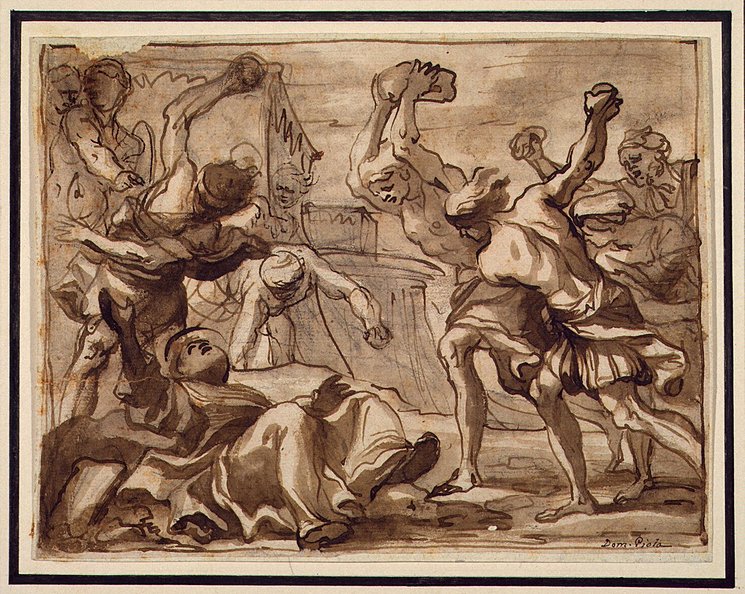
The unbelieving Jews understood the point Stephen was making and became “enraged and ground their teeth at him” (7:54). Stephen declares that he sees “the Son of Man standing at the right hand of God” (7:56) and he is cast out of the city and stoned to death. After Stephen’s speech “there arose a great persecution against the church in Jerusalem, and they were all scattered throughout the regions of Judea and Samaria” (8:1). Even though the Jews meant the persecution for evil, God used it for good so that throughout the remainder of Acts, beginning in chapter 8, we see the gospel spreading out of Jerusalem and into “all Judea and Samaria, and to the end of the earth” (1:8).
Conclusion
Stephen’s speech is not a simple recitation of Old Testament history; it is a well crafted argument that turns the accusations made against Stephen against his accusers. Stephen develops his speech in such a way that the hints and subtle arguments are almost hidden until the punchline is revealed in his conclusion. But the conclusion to the speech is made all the more powerful because it draws out explicitly what was previously only implied: the unbelieving Jews have rejected God’s Righteous One, continue to resist the Holy Spirit, and have abandoned the law. Whoever rejects God and his law are consequently engaging in false worship.
Stephen’s defense, or better yet his offense, ends with his martyrdom, but one can’t help but wonder how Stephen’s speech affected a young man in the crowd named Saul, later known as Paul, who would become God’s chosen instrument to take the gospel message to Gentiles throughout the Roman empire.
Further Reading
Notes
- Marshall, I. Howard. Acts. Grand Rapids, MI: Eerdmans, 1980, pp. 131. Tyndale New Testament Commentaries.
- Koivisto, Rex A. “Stephen’s Speech: A Theology of Errors?.” Grace Theological Journal, vol 8.1, 1987, 104. (Can be read online here)
- Gaertner, Dennis. Acts. Rev. ed. Joplin, MO: College Press Publishing Company, 1995, pp. 126. College Press NIV Commentary Series.
- Polhill, John B. Acts. Nashville, TN: B&H, 1992, pp. 206. The New American Commentary; v. 26.
- Koivisto, Rex A. “Stephen’s Speech: A Theology of Errors?.” Grace Theological Journal, vol 8.1, 1987, 104.
- ibid, 106-107
- Polhill, John B. Acts. Nashville, TN: B&H, 1992, pp. 188. The New American Commentary; v. 26.
- Gaertner, Dennis. Acts. Rev. ed. Joplin, MO: College Press Publishing Company, 1995, pp. 127. College Press NIV Commentary Series.
- ibid., 130
- Kilgallen, John J. “The Function of Stephen’s Speech (Acts 7, 2-53).” Biblica, vol. 70, no. 2, 1989, pp. 186.
- ibid., 204
- Thompson, Alan J. The Acts of the Risen Lord Jesus: Luke’s account of God’s unfolding plan. New Studies in Biblical Theology; 27. Downers Grove, IL: Apollos, 2011, pp. 169. (Book review here)
- Kilgallen, John J. “The Function of Stephen’s Speech (Acts 7, 2-53).” Biblica, vol. 70, no. 2, 1989, pp. 188.
 Studies in the Bible